
 EN
EN
 AR
AR
 BG
BG
 CS
CS
 DA
DA
 NL
NL
 FI
FI
 FR
FR
 DE
DE
 EL
EL
 IT
IT
 JA
JA
 KO
KO
 NO
NO
 PL
PL
 PT
PT
 RO
RO
 RU
RU
 ES
ES
 SV
SV
 TL
TL
 ID
ID
 LV
LV
 SR
SR
 SK
SK
 SL
SL
 UK
UK
 VI
VI
 SQ
SQ
 ET
ET
 HU
HU
 TH
TH
 TR
TR
 FA
FA
 GA
GA
 BE
BE
 AZ
AZ
 KA
KA
 LA
LA
 UZ
UZ
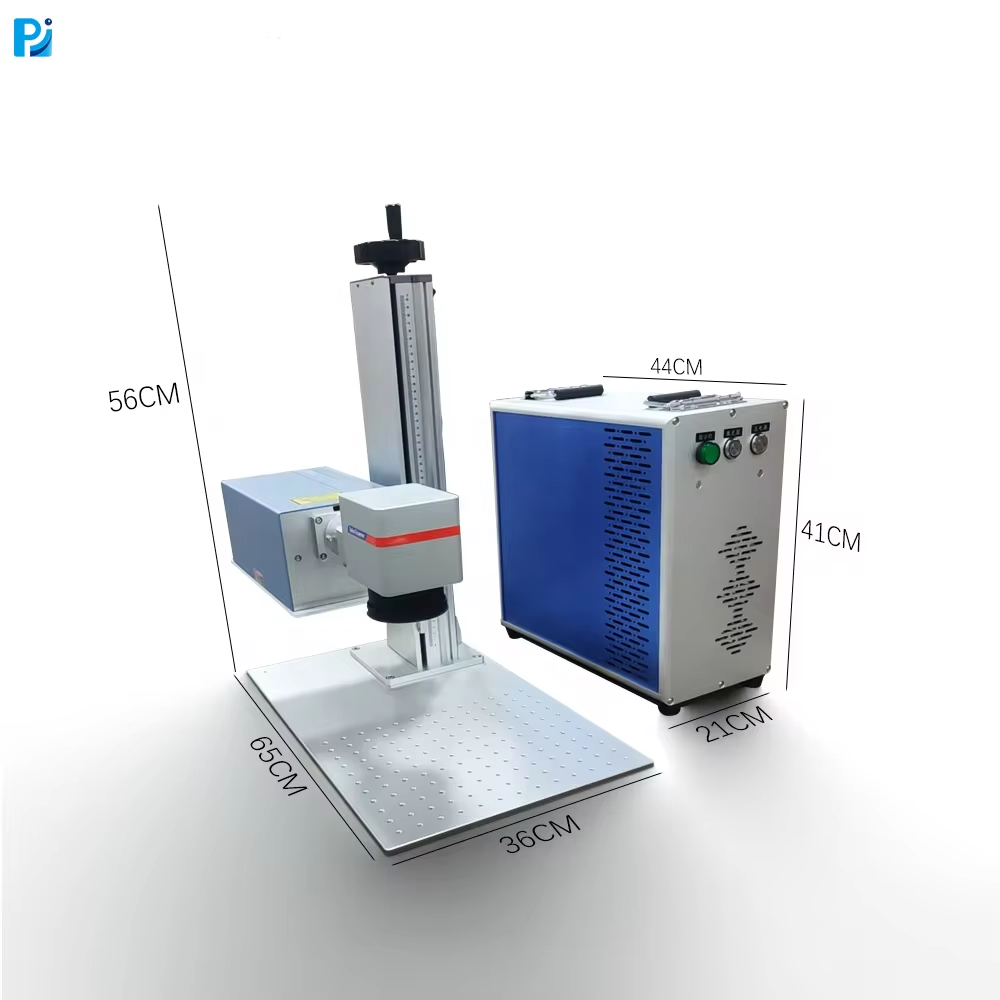
A laser marking machine is a device that uses a high-energy-density laser beam to create permanent marks on the surface of materials. During the marking process, the laser generates heat on the material surface and its surrounding area, forming a heat-affected zone (HAZ). The HAZ may cause discoloration, burning, or localized stress, affecting the marking quality. This article analyzes the HAZ from three aspects: formation mechanism, influencing factors, and control methods.
1. Formation Mechanism of the Heat-Affected Zone
During laser marking, the laser beam is focused onto the workpiece surface through a focusing system. The material absorbs the laser energy, rapidly heats up, and undergoes local vaporization or melting. The surrounding area that is not fully vaporized experiences temperature rise due to heat conduction, forming the heat-affected zone. Key characteristics of the HAZ include:
Dependence on spot size: Larger laser spots distribute heat over a wider area, resulting in a larger HAZ.
Material thermal conductivity: Metals with high thermal conductivity disperse heat quickly, resulting in a larger HAZ, while materials with low thermal conductivity confine the heat, resulting in a smaller HAZ.
Pulse energy and duration: High power, long pulses, or continuous-wave modes tend to increase heat diffusion.
2. Factors Affecting the Size of the Heat-Affected Zone
Laser power
Higher power results in greater energy absorption, faster surface temperature rise, and wider heat diffusion, enlarging the HAZ.
Pulse width and repetition rate
Short-pulse lasers concentrate energy, confining heat to the focal point and minimizing the HAZ. Long pulses or high repetition rates can accumulate heat, increasing the HAZ.
Spot size and focus position
Small, accurately focused spots concentrate heat, producing clear marks. Large spots or focus misalignment disperse heat and enlarge the HAZ.
Scanning speed
Slow scanning causes the laser to dwell longer on the same area, increasing heat accumulation. Faster scanning reduces local temperature rise and shrinks the HAZ.
Material properties
Thermal conductivity, absorption rate, and melting point of the material directly affect heat diffusion. For example, aluminum and copper have high thermal conductivity and a large HAZ, while plastics and ceramics have a smaller HAZ.
3. Methods to Control the Heat-Affected Zone
Optimize laser power and pulse parameters
Adjust power, pulse width, and repetition rate according to material properties to concentrate energy at the focal point without excessive diffusion. Short pulses with high peak power effectively reduce the HAZ.
Adjust the focusing system
Select an appropriate focal length lens and ensure the focal point is accurately on the material surface to prevent heat dispersion. Smaller spot sizes reduce the HAZ.
Increase scanning speed
Increase the speed of galvanometer scanners or XY stages to reduce laser dwell time, minimizing local heat accumulation.
Stepwise or multiple passes marking
For dark or thick materials, use multiple low-energy passes to gradually accumulate heat without creating an excessive HAZ.
Auxiliary cooling
Use air blowing or water cooling during marking to remove surface heat and control heat diffusion.
Select appropriate laser wavelength
Materials absorb different wavelengths differently. Choosing a suitable wavelength improves marking efficiency and reduces heat diffusion, thus controlling the HAZ.
The heat-affected zone is an unavoidable phenomenon in laser marking. However, by optimizing laser power, pulse parameters, focusing system, scanning speed, and applying cooling measures, the size of the HAZ can be effectively controlled, ensuring marking quality. Controlling the HAZ not only improves marking clarity and precision but also reduces material deformation and surface damage, making it a key technology for high-precision laser marking.